I-Kuan Tao
一貫道
Símbolo del Yiguandao.
I-Kuan Tao (I.K.T.) o
Yīguàn Dao, (
一贯道, traducido como "la verdad ", "el omnipresente") es un
nuevo movimiento religioso que se originó en
China en el
siglo XX.
Incorpora elementos del
confucianismo, el
taoísmo y el
budismo chino y reconoce la validez de religiones no vinculadas a la tradición china como el
cristianismo y el
islam. Por esta razón, suele clasificarse como una secta
sincretista o sincrética, junto con otras religiones similares en la Vía de la ex Cielo (Xian Tian Dao) de la familia.
I-Kuan Tao floreció en Taiwán a partir de la década de 1970. En la actualidad, es la tercera fe más popular en
Taiwán (después de
budismo y
taoísmo). Afirma dos millones de miembros, junto con las comunidades chinas de ultramar de todo el mundo.
The Great Chant
大眾肅靜,各列齊班,俱整衣冠,誠敬聽宣,八卦爐中起祥煙,育化聖☉降臨壇,關帝居左純陽右,二十八宿護法壇。老☉至壇,諸神儼然,右指呼叱,左指呵鞭,雷部、風部、虎部、龍部,各顯威嚴,爾等恭立,細聽吾言,今逢三天,大道顯然,諸部神真,護庇靈壇,鬼神聽旨,切實冥頑,遇難救難,遇災除焉,遇善相助,遇事相辦,大劫遠退,星耀靈官。領帝敕令,速辦天盤,三曹之事,一一詳參,不准退意,時時皆然,各盡爾職,鎮壓三天。☉命諸真,代吾傳宣,見道成道,運轉坤乾,十二元辰,各俱其天,時勢將至,毋違持宣。
This is the Great Chant. It is to call upon all the saints and sages in your presence. Recite this loudly everyday and you will be protected. This chant has been kep as secret for a long time, and I am revelaing this to share my secret of success.
All silence, the out-pronged classes are full dressed, Cheng Jing Hui Dragon & listen to propaganda, Baguazhang Qixiang furnace smoke, Infertility altar of Lau Mu come, Guandi left, Lu DongBin right 28 law enforcement altarLau Mu to the altar, like gods, right Call refers to the left means Oh whip, Ray Department of the Ministry of the wind, the Tiger department, the Department of Liuzhou, the remarkable dignity, All listen to this every three days, Road Clear, God really descent, retaining Belilios Ling Tan, Spirits aims to listen to, and effectively impervious to the victims and rescue, disaster event in addition to behavior, when good help, when they should phase big calamity back,Soul Officer.
Royal Decree from Dili, run day-speed disk, Cao three things, one by one in detail Senate, are not allowed to retire Italy, always alike, the best post of Seoul, the suppression of three days. Lau Mu from real life, on behalf of my Xuan Chuan, see Daocheng Road, running dry-kun, 12 yuan-chen, the all their days, the trend of the times is approaching, it is not against holding declared
Heavenly Portal

The Heavenly Portal 玄關 is a gate for the opening of light that offers divine protection by which angels and heavenly beings can come and go, without demonic interference. God has designed portals to begin in the third Heaven, travel through the second Heaven, and open upon Earth.
It is also called the Third Eye. The first treasure of I Kuan Tao. If the eyes are the windows to the soul, then the portal is the doorway.
Once this Portal has been pointed and opened by an ordained Master in the initiation ritual, it becomes a powerful tool that can be very useful in daily life as well as in times of danger.
The Heavenly Portal is a direct link to our true selves, allowing us to tap into the greater consciousness we all possess. If the spiritual self is light, then the Portal is a way to concentrate that light into a coherent beam, with laser-like brilliance and effectiveness.
Divine Mantra
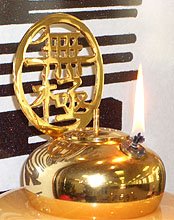
This is the Light of Life.
Say the Divine Mantra or True Sutra in Your heart to escape from calamity.
This is the second treasure of I Kuan Tao. It consists of sounds without words, so it is also known as the Wordless Sutra. It is a mantra of power that resonates at a level beyond the sound waves and writings of the material world.
The Divine Mantra should not be said aloud or written down for a very specific reason. Sages observe the typical process of reading sutra and notice that it goes through many transitions. First, the sutra starts in the eyes as the reader looks at a page. Then, it comes out of the mouth as the reader reads it aloud. Next, the sound from the reading goes into the ears as the reader hears his or her own voice. Only after all this does the sutra finally reach the heart.
Many people are not aware of the True Sutra, but it’s not a new idea. The concept goes back at least 2,500 years. The Tao Te Ching tells us that “The Tao that can be spoken is not the eternal Tao.” Similarly, when the Sakyamuni Buddha wanted to pass on his true teachings, he chose to do so without words. He specifically told his disciples that his transmission of the spiritual essence would be totally apart from written scripture. Instead, it would pass directly from one heart to another.
Sound energy is the intermediary between the metaphysical realm and the solid matter of the material world. The True Sutra, as the soundless sound, is a particularly powerful way to invoke the Buddha nature that exists in all of us.
We can use the True Sutra when we encounter challenges in life. Perhaps you see an obstacle that seems too difficult to overcome; perhaps there is a temptation that seems too strong to resist; perhaps you find yourself in a confrontational situation and it is becoming harder and harder to remain polite. Whenever you feel you need extra assistance from a source outside of yourself, repeat the mantra silently to yourself. A wellspring of strength will emerge for you.
This strength seems to come from an external source, but in fact originates from the Buddha within. The essence of Buddha nature is compassion, and as Lao Tzu points out in chapter 67 of Tao Te Ching, compassion is the source of courage. Courage is the source of strength – not the false strength of brute force, but the true strength of character and heart.
The True Sutra will allow you to achieve more than you ever thought possible. If obstacles and temptations in life are like the morning fog, then the True Sutra is like the sun. When the sun comes out, the fog dissipates into nothingness. This is the second treasure of I-Kuan Tao.
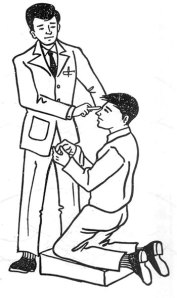
The first treasure of I Kuan Tao is the Heavenly Portal. It is the spiritual nexus of your being. If the eyes are the windows to the soul, then the portal is the doorway.
The Heavenly Portal is not well understood by many people.
Once this doorway has been pointed and opened by an ordained Master in the initiation ritual, it becomes a powerful tool that can be very useful in daily life as well as in times of danger.
Because of the frantic pace of modern life, we can often find ourselves in chaotic situations. Our thoughts are scattered everywhere, and we’re pulled in several directions at once. When that happens, think of the Heavenly Portal as the center of your universe, and visualize all your scattered thoughts coming back to it. In an instant, you’ll find that a path of simplicity emerges out of the chaos, allowing you to deal with complex demands much more easily.
When a dangerous situation suddenly appears, it is easy to succumb to fear and panic. This serves only to confuse and overwhelm us even more, and lead us to harm. The Heavenlu Portal gives us an alternative. By bringing awareness to it, you will immediately bring about a new clarity and calmness. Armed with clear mind and alert composure, you will have the best possible chance to extricate yourself from the situation.
I Kuan Tao (Tian Tao) - Yi Guan Dao
Buddhismaustralia.org 2012-06-04
The following information has been compiled from sources on the web. The content does not contain comment by the Webmaster of this site and should be considered on its own merit. If any organization listed can show that it has been misrepresented, we apologize, and, if the content can be proved to be untrue, we will remove it. However, we currently believe the content to have substance.

The followers of I Kuan Tao claimed that it is a distinguished lineage back over 2000 years when it begins from the ancient Chinese astrologers, emperors, Confucius, and so forth. From 18th Ancient Patriarch Mencius, the lineage travels to the west, the lineage began from Shakyamuni Buddha, Mahakashyapa to 28th Indian Patriarch Bodhidharma.
But the modern practice of Tian Tao, as we know it today, was established about 70 years ago. In the 1930, Shi Zueng Zhang Tian Ran and Shi Mu Sun Hui Ming, became the 18th Patriarch and started their practice I Kuan Tao in Chi Nan City, Shang Dong Province of China. Their work spread by word of mouth, and by 1946 I Kuan Tao became prevalent among 36 provinces of China. At the end of the Civil War in 1949, many followers in China found their beliefs incompatible with Communist doctrines.
This and other reasons compelled large numbers of them to emigrate to Taiwan, Hong Kong, Korea, Japan, Singapore, Malaysia, Thailand and the Philippines. Tian Tao quickly took root in these new lands, spreading with its teachings Chinese culture and traditional family values. By increasing the number of I Kuan Tao temples, they believed that they are bringing the Buddhist "Western Paradise" to earth and creating a world of brotherhood and universal love as envisioned by Confucian teachings.
Presently, they claimed that the founder, 17th Patriarch Lu Zhong Yi, was an incarnation of Maitreya. He has major influence and impact on the present form of I Kuan Tao. The central teaching of Tian Tao, is based on the initiation ceremony - a new formula on the Triple Gem, namely:
1. Opening of Heavenly Eye (Dian Xuan Dao),
2. Oral Transmission of the Maitreya prayer (Chuan Ko Jue), and
3. Hand Gestures (Jie He Tong).
They believe that the recipient has obtained the Tao and that his name has been reserved in the heaven and erased from the lists in hell. Upon death, the recipient will ascend straight to heaven without having to endure the cycles of rebirth.
--------------------------------------------------------------------------
Graeme Lyall (Australia), 1999, wrote:
"The group is known as Ee Kwang Tao (Yi Guan Dao). I was invited to attend the opening of one of their 'Holy Houses'. It was one of the strangest rituals that I have ever witnessed. Following the ritual we were invited to go before the 'Master' to receive initiation. I declined on the grounds that I had been invited to attend the opening but not to join anything. After a while they approached me again and they said that the 'Master' was waiting for me and I MUST go before the 'Master'. I replied that I must not do anything of the sort as I am a traditional Buddhist and had no wish to join their organization. I thanked them for their hospitality and said that I was leaving. As each person arrived they took their name. As I left they asked me for my name as they said that the names were being sent to heaven and, as I refused initiation, my name would have to be struck off the list. I consulted a Chinese friend about my experience and he immediately identified it as the Ee Kwang Tao cult which, as was said, is proliferating in Australia. The initiates are sworn to secrecy with the threat of harm to themselves and their family if the secrets are revealed. This dangerous cult bears no relation to Buddhism so beware of them."
Una encuesta realizada en 2002 mostró que había 845.000 seguidores con más de 3.100 templos.
En la República Popular de China, I-Kuan Tao y los otros cuatro
grupos de ex Camino de cielo religioso están prohibidas las sociedades
secretas, como fue el caso de Taiwán hasta 1987.
Existe una sede internacional desde 1996 en
El Monte,
California,
Estados Unidos.
El Nombre
I-kuan (
Yiguan, el 一貫) significa “penetrar con uno”, “consistencia” o
“una unidad.” Este término se deriva de un paso de la Analectas (4.15)
donde Confucio dice que su manera es la “de una verdad de
todo-impregnación” (吾道一以貫之 zhi guan del yi del yi del dao del wu).
Tao (Dao, el 道) tiene muchos significados, incluyendo “manera”, la
“trayectoria” o la “verdad”. Cuando está utilizado al lado del nombre de
algunas religiones chinas, significa la “religión.” Por ejemplo,
Silbido de bala Tao de Tai (太平道), un grupo religioso renegado de la
antigua China que había conducido directamente a la declinación del
Dinastía del este de Han. La misma palabra Tao ha sido utilizada por el
Taoismo y las tradiciones Confucianistas para describir los amplios
patrones del universo, de la vida, y de la humanidad así como la
manifestación ritual o religiosa.
Debido al nombre, I-Kuan Tao es a menudo supuesto como
taoísta,
y es que el taoísmo en efecto, forma parte de su patrimonio. Sin
embargo, su historia, enseñanzas, prácticas, y liderazgo son diferentes
de los de cualquiera de la "elite" de las formas de la religión taoísta
(los Maestros Celestiales o escuelas de pureza absoluta) o la religión
tradicional china de las masas. De la misma manera, I-Kuan Tao difiere,
aunque también se asemeja, al
confucianismo y al
budismo chino.
Debido a que el grupo fue prohibido en
Taiwán
en los años 70 y 80, se manifiesta en diferentes nombres, tales como
Confucio, Mencio, La sociedad, la moral de la sociedad, etc. También se
llamaban a sí mismos Zhenli Tiandao (真理天道El Tao Celestial)
Deidades
- Ming Ming Shang Ti
(明明上帝), "Emperador luminoso de lo alto" - similar a la judeo-cristiana
de Dios. También se conoce como Wuji Laomu (无极老母), la Madre "Anciana del
cielo ilimitado".
- Ella (o él) es el gran ser que trasciende todos los
dioses menores del panteón chino. El nombre completo más o menos
traducido de esta deidad es la luz eterna Todopoderosa Ilustre Pura
Tranquila Vacía sagrada y venerable, El Señor de todos los seres del
Universo entero.
- Maitreya
(弥勒佛), el próximo Buda para suceder al Buda histórico Shakyamuni, y que
ha llegado ya de acuerdo con I-Kuan Tao. Maitreya se reencarnó como Lu
Yi Zhong. # Ji Gong (济公活佛), conocido como Buda Viviente Ji Gong (Huofo
Shizun) un monje budista Zen venerado como la reencarnación de un Arhat.
Zhang Tian Ran, fundador de la I-Kuan Tao, se cree que es la
reencarnación.
- Ji Gong, (济公活佛), conocido como Buda Viviente Ji Gong (Huofo Shizun) a Zen monje budista reverenciado como una reencarnación de un Arhat. Zhang Tian Ran, el fundador de la I-Kuan Tao, se cree que es la reencarnación.
- Yue Hui, (月慧菩萨) es el Bodhisattva Sabiduría Luna que era la reencarnación como dom Su Zhen, la matriarca de la I-Kuan Tao. Se confunde a menudo con Guan Yin, que comparte la misma imagen.
- Lu Dongbin(吕洞宾) es una deidad china / Immortal.. Lǚ Dongbin es el más conocido del grupo de las deidades conocido como el de los Ocho Inmortales.
Maestros
- Lu Zhong Yi
(路中一), el Patriarca 17 de I-Kuan Tao. Se cree que es la encarnación de
Maitreya. Alcanzó el título en 1905, cuando Dios le encargó continuar
con el linaje de Tao.
- Zhang Tian Ran
(張天然), hizo la I-Kuan nombre oficial de Tao, fue el patriarca 18. Se
cree ser la encarnación de Ji Gong, y se convirtió en Tianran Antigua
Buda después de su muerte.
- Sun Su Zhen
(孫素真), el I-Kuan Tao matriarca 18 y la esposa en el nombre de Zhang
Tian Ran. Ella se creía que era la encarnación de Yue Hui Bodhisattva y
se convirtió en la Santa Madre de los chinos después de su muerte.
Prácticas
I-Kuan Tao representa una sociedad moralista, con el objetivo de
ayudar a salvar a todos los humanos del último desastre (el
apocalipsis). Los miembros son animados a seguir prácticas morales,
tales como:
- Las "cinco éticas" y las "ocho virtudes" (del confucianismo)
- El vegetarianismo y la abstinencia de alcohol y el tabaco (como en el budismo chino)
- Iniciación de nuevos miembros en "Tao" (similar a la naturaleza de Buda en Ch'an).
- Oración diaria (2 ~ 3 veces)
- Asistir a clases de religión, ceremonias, ofrendas, oraciones, etc.
- Hacer escrituras de canto (como en todos los movimientos religiosos y las religiones chinas)
Los seguidores de I-Kuan Tao son alentados a ayudar a traer y poner en marcha los nuevos miembros, el
vegetarianismo y la práctica de abrir los templos o altares en sus hogares.
Estructura
A diferencia de otras religiones, I-Kuan Tao no tiene una sola
organización. Esto es porque después de la muerte de Zhang Tian Ran y la
huida del
comunismo chino,
muchos de los seguidores han encontrado su propio camino a Hong Kong y
Taiwán. Ellos establecieron sus propios grupos, sobre todo después de
los nombres de sus templos ancestrales de China, la difusión de las
enseñanzas de la I-Kuan Tao. Existe un consenso de los seguidores de
Zhang Tian Ran y Sol para formar la sede de la I Kuan Tao, el
reconocimiento de los llamados "grupos de dieciocho".
Aparte de estos "dieciocho", hay un grupo independiente iniciado por
la esposa y el hijo de Zhang Tian Ran, señora Liu y el Sr. Zhang Yingyu,
que no tiene muchos seguidores. Un grupo escindido grande, también
reconocido por el gobierno de Taiwán, pero no reconocido por el I-Kuan
Tao, es aquella fundada por
Wang Hao De, ex asesor del Sol, que estableció su propia organización llamada la
Gran Tao de Maitreya.
Historia
Dentro de la amplia categoría de la religión china, podemos
distinguir entre las prácticas tradicionales que no esperan compromisos
de adhesión ni con exigencias claras y, por otra parte, varios
movimientos sectarios que gozan de una identidad más clara y, al mismo
tiempo, una débil influencia sobre el sociedad en general. La gente en
las prácticas religiosas son absorbidos casi inconscientemente, desde la
infancia. La identidad religiosa sectaria debe ser elegida
voluntariamente. Tal identidad sectaria podría ser budista, cristiana, o
cualquiera de los movimientos religiosos que se han originado en el
ámbito cultural chino.
Algunos movimientos sectarios religiosos, como el Budismo Chan (Zen
japonés) pueden durar siglos y se rigen por el estado. Otros son más
efímeros, como la familia de los movimientos budistas reunidos bajo el
nombre de Loto Blanco. Estas fueron vagamente inspiradas en los
vegetarianos, las religiones milenarias, la religión sincretista del
maniqueísmo, que ha sobrevivido en China - y asimilada en la cultura
china - un total de mil años después de que estas habían desaparecido en
el Oeste. Las sectas del Loto Blanco tienden a ser suprimidas por el
Estado, pero pasaron a tener ciertas influencias en grupos posteriores,
como el
Tien Hsien.
Philip Clart (enlace más abajo)hizo el siguiente resumen de la historia de la I-Kuan Tao:
- "También se llama T'ien-tao (" Camino del Cielo "). Fundada en 1930 por el patriarca de la " XVIII" Chang Tien-jan (1889-1947) en la ciudad de Chi-nan, la capital de la provincia de Shantung,
la secta en 1934 trasladó su centro de actividad a T'ien-mentón y desde
allí se extendió rápidamente por toda la China continental. Después de
la muerte de Chang Tien-yan en 1947, el liderazgo nominal de la secta
pasó a manos de la matriarca, la señora Hui-Ming.
Sin embargo, la secta se dividió en una serie de ramas separadas (por
lo general dijo a los dieciocho años) que ha seguido más o menos
independiente. Así pues, no existe hoy en día la dirección independiente
de la secta, que se ha convertido en una familia estrechamente
relacionada con las asociaciones de la rama aún autónomas ".
Historia oficial
La historia oficial de I-Kuan Tao afirmó que la I-Kuan Tao Tao se puede dividir en tres períodos. El primero es
la línea 18 a principios del Este, se originó en la figura mítica
Fu Xi, el creador del
bagua. A este le sucedieron otras figuras míticas e históricas como
Shen Nong,
Huang Di (Emperador Amarillo),
Laozi el autor del
Dào Dé Jing,
Confucio, y el último
Mencio. Se dice que a causa de la crisis en China, Laozi Tao fue llevado a la India e inició el
Buda Sakyamuni.
El segundo linaje, llamado el
28 de linaje del Oeste, comienzó. Esto siguió a la
Ch'an budista
zen o el linaje de
Sakyamuni a
Mahakasyapa y, finalmente,
Bodhidharma. Se dice que Bodhidharma llevó el Tao de nuevo a China para comenzar
el 18 linaje oriental tardío. Tras el linaje Zen de Bodhidharma, llegó al sexto y último patriarca oficial del Ch'an chino,
Huineng. El linaje continúa con figuras sectaria.
Una investigación señaló que se debía a la
Xiantiandao (先天道) o la Vía de la ex Cielo. El fundador de Xiantiandao es
Huang Dehui
(黄德辉, 1624-1690). El I-Kuan Tao y el Xiantiandao lo consideraba como el
patriarca de sesiones. Los resultados de los documentos de la dinastía
Ching Wang mencionaron que
Jueyi (王觉)一, (1821-1884), el patriarca 15, había reproducido otra enseñanza religiosa, diferente a I-kuan Tao, llamada
Sanjiao Yiguan Zhizhi (Unidad de las tres religiones) en la década de 1850.
Sin embargo, I-Kuan Tao, comenzó a florecen en China durante la dirección de
Zhang Tian Ran. Durante la dirección de Zhang Tian Ran, I-Kuan Tao se propagó de
Shandong
hacia otras muchas ciudades en Norte, Centro y Sur de China. Zhang
murió poco después durante la guerra civil en 1947. Después de la muerte
de Zhang, la señora Su Zhen (孙素真), lo sucedió como matriarca de la
I-Kuan Tao.
De acuerdo, con los creyentes de I-Kuan Tao, la señora Sun no era
realmente la esposa de Zhang. En una época caótica en China, junto con
el pensamiento tradicional, común entre las comunidades chinas en ese
período, no es apropiado que un hombre y una mujer que no tenía ninguna
relación familiar, viajasen juntos, y fue muy mal visto. Para silenciar a
los críticos y las ideas erróneas del público,declararon que estaban
casados el uno con otro. Se casaron en el nombre, pero nunca fueron un
verdadero matrimonio, fue un matrimonio de conveniencia.
Cuando el comunismo tomó el poder en China, muchos seguidores de
I-Kuan Tao y sus líderes emigraron a Hong Kong y Taiwán. En 1951, I-Kuan
Tao fue prohibida en la República Popular China y muchos de los
seguidores y dirigentes fueron perseguidos. Su Zhen y otros líderes de
Kuan Tao salidos de China, y llegaron a Hong Kong. Sun luego se trasladó
a Taiwán en 1954, donde vivió como un recluso virtual bajo el cuidado
de los seguidores como Wang Hao De, hasta su muerte en 1975.
En la actualidad
Zhang Pei-Cheng, es el actual director de I-Kuan Tao, uno de los
muchos que llevó las enseñanzas de la fe a Taiwán en 1947.(Se ha
fallecido en el año 2010)
Hoy en día, la secta de los grupos de culto tiene 50.000 solicitudes
(30.000 en Taiwán) y soporta varias escuelas como la Universidad de
Sung Nien (Taiwán). Sus miembros operan muchos de los restaurantes vegetarianos.
Referencias
Hay muchos estudios occidentales sobre este movimiento. El primer
estudio completo es de David K. Jordan y descrito en su libro The Flying
Phoenix. [Cita requerida]
Los estudios recientes incluyen Philip Clart y una tesis de Jo
Swinnen (en neerlandés) de la Katholieke Universiteit Leuven. Un libro
de Meir Shahar el titulado Crazy Gong Ji Ji tiene una sección en la
I-Kuan Tao. [cita requerida]
Ver también:
- Robin Munro: "sincrétismo Sectas y sociedades secretas - Revival en
la década de 1980." En: Sociología y Antropología de China (ME Sharpe,
Armonk, NY) Verano 1989/Vol. 21, No. 4
- Song Guangyu(宋光宇): Tiandao Gouchen (天道钩沉), 2. Ed. Taipei 1983
- Thomas Weyrauch: Yiguan Dao - Chinas im Untergrund Volksreligion. Heuchelheim (Longtai) 2006. ISBN 3-938946-02-4
Enlaces externos
Zhang Tianran (張天然) (8 August 1889 – 29 September 1947) was the eighteenth patriarch as well as the founder of the
I-Kuan Tao religious sect. He is usually referred to as the
Father of I-Kuan Tao, or as
Shi Zun (師尊), meaning the
Honored Teacher.
Early life
He was born under the name
Kui Sheng, and also as
Zhang Guang Bi.
Zhang Tian Ran was his official religious name. He was also known as
Kung Chang
(Kung and Chang are the two readings of the character Zhang). Zhang was
born on the 19th day of the 7th Lunar month in 1889, in
Jining prefecture, northern province
Shandong.
In 1908, Zhang married with a woman named Zhu, but Zhu died a year
later. Two years later Zhang married again to a woman of the surname
Liu.
He left home and traveled to
Nanjing and
Shanghai. At age 24, Zhang joined the army as a low ranking military officer. Zhang was then initiated in
I-Kuan Tao in 1914. The 17th patriarch
Lu Zhongyi heard the conduct of Zhang and told Zhang to join in
Jining.
Lu died in 1925, and was succeeded by his sister, Lu Zhongjie who
temporarily looked after I Kuan Tao for 6 years. In 1930, Venerable
Zhang and Sun Su Zhen became the 18th patriarch.
Leadership in I-Kuan Tao
There are various versions concerning the transfer of the 18th patriarch and the meeting of Zhang Tianran with
Sun Suzhen.
The most simple version states that the Venerable Mother transferred
the 18th patriarchs to both Zhang and Sun. The most widely accepted
version in Western literature states that Zhang took Sun Suzhen as his
second wife in 1930. She was already a member of I-Kuan Tao and it was
believed that Zhang married her after a "divine message". The Eastern
account however, states that He married her in name only, since it was
inappropriate at the time for an unmarried woman and a man to be seen
traveling around alone together, which they often did to carry forth
their mission, hence, their "marriage" was to quell rumours and societal
taboos. In truth, they were never married.
[citation needed] Zhang was considered as the incarnation of
Ji Gong, a Buddhist monk who was revered as an incarnation of an
Arhat
by Buddhists and also Taoists. Sun was then considered as the
reincarnation of Yue Hui (Bodhisattva of Moon Wisdom). Yet, it is noted
that Zhang and Sun were husband and wife in name without intimate
relationship. Sun was only responsible for leading and propagating Tao.
He didn't have much time for his kids but he had exactly 12. He would
make time to spend with them.
Zhang moved out of Jining, and in 1931 traveled to
Jinan the capital of
Shandong, to spread the teachings. He founded the Hall of Lofty Splendor (
Chong Hua Tang)
and attracted many followers. These first followers later become
Zhang's apostles. From Jinan I-Kuan Tao spread quickly throughout North
China. Within a year, four more temples were established. In 1934, Zhang
went to
Tianjin established another temple and became the base of the propagation. In 1937, Tianjin had more than 100 temples. From
Tianjin, Zhang's disciples propagated the teaching to various parts of China.
Under the Japanese occupation, I-Kuan Tao survived and spread rapidly, centered in Central China. The cult with
apocalyptic beliefs and strong
mystical
elements attracted many. The political chaotic, fear and panic
situation in this period helped I-Kuan Tao grow more rapidly. The
apocalyptic teaching promised that by following I-Kuan Tao, one would be
spared from calamity. By 1940, I-Kuan Tao reached the southern province
of
Jiangxi. I-Kuan Tao also attracted a number of officials of the Japanese puppet government of
Wang Jingwei. During 1950, it was estimated in Beijing there were about 178,000 followers, and in Tianjin, 140,000.
Death
After the war ended, Zhang was sick and accused of conspiring with
the occupying Japanese army. He died on the 15th day of the 8th Lunar
Month, the Mid Autumn Festival, on 29 September 1947, in the city of
Cheng Du in
Sichuan province. He was buried in
Hangzhou.
[citation needed]
See also
References
- Thomas DuBois. 2005. The Sacred Village: Social Change and Religious Life in Rural North China. University of Hawai'i Press. ISBN 0-8248-2837-2
- David Jordan & Daniel Overmyer. 1985. The Flying Phoenix:
Aspects of Chinese Sectarianism in Taiwan. Princeton University Press. ISBN 0-691-07304-X
- Soo Khin Wah. 1997. A Study of the Yiguan Dao (Unity Sect) and its
Development in Peninsular Malaysia. Ph.D. dissertation, University of
British Columbia.
- Jo Swinnen. 2003. Yiguan Dao: Aspecten van een Moderne Chinese Religie. Katholieke Universiteit Leuven. [1]
External links
Here is some history on JiGong:
 |
| JI GONG 'Mad Monk" |
JiGong had many names. He was born under the name Li Xiuyuan. He was also called DaiJi 道濟禪師 because people in the Taoist Religion also revered him.
His Buddhist name was JiGong huo fo 濟公活佛 - or full name "Living Buddha JiGong."
That was quite a title to
give someone who was kicked out of the temple because he refused to
follow the rules.
In today's modern world, he is also known as "The Mad Monk" and also the "Robin Hood" of China.
He
was born to a former military advisor, Li Maochun. His parents were
not allowed to have children, therefore they sent him to live in a
temple. Upon reaching the Hall of the Five Hundred Arhats, the statue of Mahakasyapa
was knocked off its lotus throne. This was considered a sign that the
arhat had descended to earth - in the form of little Li Maochun.
After his parents' death, he went to Hangzhou and became a monk at the famous Ling Yin Temple near Hangzhou. Li Gong's eccentric behavior broke the rules of the vinaya (traditional code for monks). However, he always had a smile and a kind heart and never failed to help ordinary people.
Unlike a traditional
Buddhist monk, he ate meat and drank wine. He believed that what is
in your heart and soul is more important than following strict rules.
Therefore he marched to his own drummer, regardless of the scoldings
and punishments he received. The leaders of the monastery finally tired
of his behavior and kicked him out. From then on, JiGong roamed the
streets and helped people whenever he could.
While meditating
and studying the Buddha's teaching, JiGong acquired magical powers.
Because of his compassionate nature, many people started thinking of him
as an incarnate of a bodhisattva, or as a reincarnate of an arhat. He was soon recognized as the incarnate of the Taming Dragon Arhat 降龍羅漢.
When JiGong died at the Jing Ci monastery on the 14th day of 5th Lunar month (17 June 1207), Syncretic Taoism began to revere Daoji as a god from heaven and later adopted him as a deity. Not long after that, even Buddhism began to respect him, and added him into the list of arhats.
His statues and pictures
often depic JiGong with a mischievous smile, a bottle of wine in one
hand, and a magic fan in the other hand.
Today, allow me to share with you another powerful, thought not
very famous, wealth god called Ji Gong or Che Kong (濟公). Also spelled as
Ji Kong or Che Gong.

Ji Gong is known as the ‘
Legendary Monk with a Magical Fan’.
This is
because he is usually portrayed as having a fan and sometimes with a
bottle of wine.
I entitled this post as – JI GONG: AN ECCENTRIC BUDDHIST MONK THAT
BECAME A TAOIST WEALTH GOD – because Ji Gong in reality was a Buddhist
monk, was expelled from his monastic life and later on became a Taoist
wealth god. The irony here, is that he’s not considered as a Buddha or a
Bodhisattva in Buddhism, and it was only after the Taoist has adopted
Ji Gong as a deity did the Buddhist started including him in their
Koans.
(A Koan, for lack of a better description, is like a form of Sutra.
It’s a fundamental part of the history and lore of Zen Buddhism and it
consists of stories, dialogues, questions and statements, the meaning of
which are said to be understandable through intuition or lateral
thinking. )
Ji Gong was born to a famous and rich family during China’s Southern
Song Dynasty. His father is a highly respected ‘businessman’ and
military advisor. Ji Kong, the only son, and whose real name is
Li
Xiuyuan (李修元), came late in the family. His parents were actually told
by a respected Feng Shui consultant that they don’t have descendant’s
luck and that they will never have any children. This cause great
sadness to both his parents, and considered this as one of their
greatest misfortune. Since they are a religious couple they decided to
make sure that they would go on various pilgrimage to different temples
to ask for child.
Like most Chinese then and now, they don’t really make any
distinction between Buddhism and Taoism and they would visit temples
from both religions even if they were really Taoist.

It is said that in one of their pilgrimage to a Buddhist temple, they
entered the hall of the 500 Arhats. Whereby the image of one of the
Arhat, Mahakasyapa, fell off from the altar. It was taken as a sign that
at that moment Mahakasyapa’s energy or spirit left ‘his’ image.
Not long after that, Ji Kong’s mom found out she was pregnant. They
remembered the incident in the temple and believed that the baby in her
womb was a gift from the Buddhas. They even began to think, that what
she was carrying in her womb is the reincarnation of the Arhat
Mahakasyapa!
At the age of 18, Li Xiuyuan decided to go to Hangzhou (a province in
China), to enter the monastic life at the famous temple called Ling Yin
Temple. After several years of studying Buddhism, he was finally
ordained as a Buddhist monk and named Dao Ji Chan Shi. He was then
normally called Dao Ji, thus this has become another common name of Ji
Kong.
His monastic life proved to be short but memorable. Being born from a
very rich family, he’s used to eating meat and drinking wine, and he
was unable to give this up when he became a monk. Furthermore, he
started showing some eccentricity and it is believed that he is slightly
mad. However, they all agree that he is kind hearted and generous.
Nevertheless, because Zen Buddhists strictly prohibits eating of meat
and drinking of wine, they really didn’t have much choice but to expel
him from the monastery.
After being expelled from his monastic life, Dao Ji or Ji Kong never
really bothered to search for another monastery that can adopt him. He
just roam on the streets and is often thought of as beggar monk, because
he really didn’t gave up his Buddhist robes either.
His eccentricity continued to manifest on the streets, but so his
kindness and compassionate heart. It is said, the even he looks poor he
never really begged for money, and it is often a wonder as to where he
gets money for food. Some say that it could be part of his inheritance,
but if it were from his inheritance, it’s a mystery were he kept his
wealth.

However, after a while, Dao Ji or Ji Kong started to manifest another
eccentricity. Since he has a compassionate heart, he would often
approach beggars on the streets and other poor families. He would listen
to them, crack a joke, then murmur a prayer, after which he’ll use his
fan to fan them a little. Soon after these incidents the recipient of
his kindness and weird ritual will come to a good fortune. He thus
earned a reputation for being a Buddhist magician, which, in turn earned
him the title Ji Gong Huoto, which means the Living Buddha Ji Gong. Ji
is derived from his Buddhist name Dao Ji, Gong, is a respect for a
powerful elderly, and Huoto literally means living Buddha.
At his old age, Ji Kong was adopted by another monastery. This is where he passed away on the 14
th day of the 5
th
Lunar month. Right after his death, Taoist immediately adopted him as
their deity, and it is said the he continuously manifest his
compassionate and magical powers to every one who keeps his image and go
to him.
His image is usually pictured as a monk in rugged clothing, holding a
bottle of wine and a ‘magical’ fan. He is always shown with a smiling
face, because he has a very happy nature. Although, he is usually
pictured wearing a hat with the word
Fo, which means ‘Buddha’, Buddhist
never really considered him as Buddha or a Bodhisattva.
However, seeing
how much he is revered in Taoism, Buddhist did include him in their
Koans, some sub-sects even considers him as an Arhat.

This is a jade Ji Gong pendant. It's very similar to the one that I have.

--->ZEN MASTERS

濟公活佛 Jigong huofo (1133-1209), aka 道濟 Daoji
济公 Ji Gong, 李修元 / 李修緣 Li Xiuyuan, 濟顛道濟 Jidian Daoji

濟顛道濟 Jidian Daoji
Daoji (2 February 1130–16 May 1207), commonly known as Ji Gong, was a Chán Buddhist monk of the Southern Song Dynasty in China. He was born with the name of Li Xiuyuan. (李修元). Some sources have cited his name as Lǐ Xiūyuán (李修 缘, the only difference being the third character of his name). Dao Ji was also called Hu Yin (Recluse from the Lake) and Elder Fang Yuan (Square Circle). Ji Gong was a buddhist monk but drank alcohol and ate meat. His image usually wears a monk hat (called Ji Gong Mao), carrying a reed fan and a gourd.
Jigong huofo painted by contemporary Chinese artists (DOC)
马哲 Ma Zhe (1952-): 济公活佛百态图《缘起赞禅意卷》
http://www.360doc.com/content/12/0315/13/5975523_194525675.shtml
http://kadxlt.blog.163.com/blog/static/204561151201262142716627/ (1)
http://kadxlt.blog.163.com/blog/static/20456115120126214222820/ (2)
Ji Gong (濟公), The Drunk Monk - bamboo root carving
http://thetaiwanphotographer.com/taiwan-god-ji-gong-%E6%BF%9F%E5%85%AC-the-drunk-monk/
Crazy Ji: Chinese Religion and Popular Literature
by Meir Shahar
Harvard-Yenching Institute Monograph Series, 48 . Cambridge (MA) and London: Harvard University Press, 1998. xviii, 330 p.
http://ccs.ncl.edu.tw/Chinese_studies_18_2/18_2_18.pdf

Adventures of the Mad Monk Ji Gong
The Drunken Wisdom of China's Famous Chan Buddhist Monk
by Guo Xiaoting
translated by John Robert Shaw
Tuttle, 2014, 544 p.
reviewed by Vladimir K
This is the first complete English translation of a Chinese classic work that is sure to amuse and enlighten modern readers. It tells the story of the mad old Zen Buddhist monk Ji Gong, who rose from humble beginnings to become one of China's greatest folk heroes.
Follow the brilliant and hilarious adventures of a mad Zen Buddhist monk who rose from humble beginnings to become one of China's greatest folk heroes!
Ji Gong studied at the great Ling Yin monastery, an immense temple that still ranges up the steep hills above Hangzhou, near Shanghai. The Chan (Zen) Buddhist masters of the temple tried to instruct Ji Gong in the spartan practices of their sect, but the young monk, following in the footsteps of other great ne'er-do-wells, distinguished himself mainly by getting expelled. He left the monastery, became a wanderer with hardly a proper piece of clothing to wear, and achieved great renown - in seedy wine shops and drinking establishments!
This could have been where Ji Gong's story ended. But his unorthodox style of Buddhism soon made him a hero for popular storytellers of the Song dynasty era. Audiences delighted in tales where the mad old monk ignored - or even mocked - authority, defied common sense, never neglected the wine, yet still managed to save the day. Ji Gong remains popular in China even today, where he regularly appears as the wise old drunken fool in movies and TV shows. In Adventures of the Mad Monk Ji Gong, you'll read how he has a rogue's knack for exposing the corrupt and criminal while still pursuing the twin delights of enlightenment and intoxication. This literary classic of a traveling martial arts master, fighting evil and righting wrongs, will entertain Western readers of all ages!
Biography & Story of Ji Gong
http://www.mildchina.com/history-culture/monk-jigong.html
Mentioning the story of Ji Gong, in China, the first impression of people is a TV series playing the magic experiences and legend of Ji Gong, who was widely and highly respected as the Master of Zen Buddhism and the incarnation of Taming Dragon Arhat (Xiang Long Luo Han, 降龙罗汉, one of 500 Arhats in Buddhism culture). Historically speaking, Ji Gong was a true monk with a high cultivation and reputation in China. We share what we know about this figure in history and story.
Ji Gong in History
Ji Gong(济公, 1133-1209) whose earthly name was Li Xiuyuan, was born in Yongning Village, Tiantai County, Taizhou, Zhejiang Province. His father was Li Chunmao and mother had a surname Wang. At the age of 18, his parents passed away. And he went to Lingyin Temple of Hangzhou and became a monk. Since then he used the Buddhist name Daoji (道济), and his teacher was Hui Yuan, an old and blind abbot and said to know the real identity of Ji Gong. Ji Gong disliked sutra chanting and meditation sitting, and he like eating meat and drinking alcohol, and even preferred garlic dog meat. All of these foods were absolutely prohibited in Buddhism. He always wore the worn-out clothes and hats and kept a broken hand fan. Due to his unrestraint, he was accused by other monks. His teacher just said a word – “the Gate of Buddhism is so vast! Why is this crazy monk not forgiven? ”. Therefore, he had a nickname Crazy Monk(济颠). After his teacher passed away, he was forced to move to Jingci Temple. He was quite proficient in the medicine and saved many people from death, and then he was respected as Living Buddha Ji Gong. Legendarily speaking, he was the earthly Arhat of Taming Dragon. On May 16, 1209, he passed away, and before going, he left a Buddhist verse.
六十年来狼藉,- Sixty years’ life in disorder
东壁打到西壁。- From east to west, I fight always
如今收拾归来,- Today, I review and return
依旧水连天碧。- All is same as those before
He was buried in Running Tiger Spring Area, and a special monastery named Jigong Tayuan was built in memory of him. Many historical words are written in the Records of Jingci Temple.
Ji Gong in Story
The legends of Ji Gong were sourced from the late period of Southern Song Dynasty (1127-1279), and the folk storytellers begun taking his life experience as the theme, and up to Qing Dynasty (1644-1912), a storybook named Complete Stories of Ji Gong(济公全传) was published. His stories actually were sourced the story of Master Bao Zhi who living in the Northern and Southern Dynasties (420-589). Later, some folk stories and believes were blended, and Ji Gong became a featured immortal of Buddhism and Taoism. I-Kuan Tao worships Ji Gong and lists him as one of the Gods, and considers their founding master, Zhang Tianran, to be the incarnation of Ji Gong. There are lots of stories about Ji Gong. Hereinafter are the selected:
After living in Jingci Temple, Ji Gong acted as an amanuensis monk. On one occasion, the fire destroyed the main hall of Jingci Temple, the abbot turned to him for the big wood for restoring that hall, after he slept for three days because of overdrinking, he shouted at:"the wood is here, take it from well, the wood really effused from the well of temple continually until the woods were enough for rebuilding the hall. Nowadays, there is a Shenmu Well in Jingci Temple.
One day, Ji Gong fore-felt there would be a hill flying to the front of Lingyin Temple, for the sake of saving the villagers, he took the measure of looting bride to take the villages away from their houses and eventually avoided happening of disaster. This is the story illustrating the origin of Peak Flying-From-Afar (飞来峰).
If you are interested in the stories of Ji Gong, and understand Chinese, we recommend you to enjoy the solo story-telling of Guo Degang in Beijing, and his most famous story telling is the Legend of Ji Gong, in which nearly all the stories of Ji Gong are available such as Eight Devils Temper Ji Gong with Fire, Ji Gong Fighting Against Da Peng, said to be the uncle of Sakyamuni, Ji Gong Edified Yellow Weasel Spirit for Nine Times, and so on.
Ji Gong's fascination with crickets


Ji gong, often referred to as the “crazy monk”, was a nonconformist. On figurines of Ji gong, he is often holding a fan, cricket or flask. The fan symbolizes the act of letting negative energy go, and consciously bringing in positive energy. In China , people would put two crickets together and watch them fight. The cricket, in this case, symbolizes the internal battle we have with ourselves. We fight in order to develop our strengths and to understand and transform our weaknesses; it is a spiritual battle, and we aspire to constantly take ourselves to higher levels of understanding, awareness and practice. The flask Ji Gong carries represents non-attachment and the temporal nature of the material world. It is said that while he was alive, he carried around a flask which people presumed was alcohol. However, he could change the liquid to be vinegar, water or another liquid so people were constantly surprised when they drank out of it. Ji gong tried to teach others not to judge anything based on external appearances. He did not care what people looked like, or where they came from. If they had a good heart, he would try to help them. One time, Ji gong and his students were freezing cold and had no way of getting warm. Ji gong tore down the wooden altar they used for worship, and made a fire out of it. One of his students was horrified and cried out, “What are you doing? That's our sacred altar!” Ji gong took the statue of Buddha and cut it into two pieces. The student exclaimed, “You are cutting Buddha! Don't do that!” Ji gong answered, “This statue is not Buddha. This is just wood.” He wanted to teach his students how to let go of material attachments—that what really matters is the True Heart. Wood decays over time; compassion is timeless; it touches people at the deepest level. It was not important to Ji gong whether or not a person appeared to have great virtue: appearances meant nothing to him. He was only interested in the qualities of one's heart.
Monk Ji Gong
http://www.shenyunperformingarts.org/learn/article/read/item/spCxp5EyZws
Ji Gong was born to a wealthy family in the early part of the Southern Song Dynasty. As a young man, he joined a Buddhist monastery and took the name, Dao Ji. Unlike most monks, he dressed sloppily in torn rags and even on occasion ate meat. In short, he was a bit of a character, and his idiosyncrasies irked the other monks. This earned him the nickname “Ji the Crazy Monk,” later shortened to “Master Ji,” or Ji Gong.
Despite his eccentric personality, Ji Gong was sincere, kindhearted, and a well-accomplished follower of the Buddhist teachings. He was known for helping those in need and sometimes even saving their lives. Chinese folk legends fondly describe his various exploits.


Chinese Traditional Crafts Lacquer Folding Screen. There are 12 panels in total, with each panel 40 cm wide by 213 cm high. (Terebess Collection)
Summoning Logs from a Well
One popular story tells of Ji Gong using paranormal powers to pull logs out of a well. A temple was to be built in Hangzhou and desperately needed wood. The best wood was found only in Sichuan province, some 900 miles away. The monks were desperate.
But that did not stop Ji Gong. He used his powers to bring the logs over one after another. The other monks piled them up, until the monk charged with counting them suddenly shouted: “Enough!” Ji Gong had already beckoned another log, but hearing the monk yell, he stopped it. That last log remained half-submerged in the well, and later generations built a pavilion over it, naming it the “Divine Teleportation Well.”
Stopping a Flying Mountain Peak
Another story, which inspired the Shen Yun dance Ji Gong Abducts the Bride, recounts the monk’s creative ways of rescuing people from imminent danger, even if against their will.
One day, Monk Ji Gong was walking towards Lingyin Temple when suddenly he felt a sudden jolt to his heart. Sensing something amiss, he used his ability of clairvoyance to investigate, and saw that a mountain peak was about to come crashing down on a nearby village.
Alarmed, Ji Gong began shouting to the townspeople, warning them to run for their lives. But they just laughed and dismissed him as “that crazy monk talking nonsense again.” It was then that Ji Gong spotted a wedding procession in the village. He barged in, snatched the bride, threw her over his shoulder, and ran.
Alarmed, the groom and wedding guests called all of their family and friends to chase after the kidnapper. Before long, the entire village was chasing after them.
No sooner had they gone past the village gate than a giant mountain peak nearby collapsed, landing on the village with a crash. Huge rocks flew everywhere, shattering roofs and flattening buildings in an instant.
Ji Gong had rescued the village, but just then he noticed that back in the village a little girl was staggering behind and a gigantic boulder was thundering toward her. He immediately aimed his palm at the boulder and instantly forced it back with his powers, saving her life.
That famous boulder is now called Hangzhou’s “Flying Peak,” and today, visitors can see the imprint of a hand sunk into the base of the rock.
Poetic Leaps in Zen's Journey of Enlightenment
by Zhi, Yong
iUniverse, Bloomington, IN., 2012
A Salvation Story Featuring Ji-gong
We will start the examination with a legendary story about saving a person’s life, featuring Ji-gong, the most colorful Zen eccentric in the history of both Chinese Buddhism and the popular culture:
Once Ji-gong saw an old man trying to hang himself from a tree. The man made a noose and was placing his neck into it when suddenly he saw Ji-gong, dressed in rags, coming his way chanting, “Die, Die, everything is over after I die, death is better than living, I will hang myself now.” Ji-gong also made a noose and looked like he was going to hang himself side by side with the old man from the same tree. The old man was puzzled and asked Ji-gong why he, a monk, would want to commit suicide. Ji-gong told him that he was commissioned to raise money to remodel the monastery. He had begged for three years and collected some money, but on his way back to the monastery, he stopped at a bar, got drunk, and somebody stole all his money. Having no face to go back to the monastery, he decided to end his life. The old man believed his story and said, “Don’t worry, I happen to have some money, which is no use for me anymore.” He gave Ji-gong five pieces of silver, which is all the money he had. Ji-gong took the silver and said, “Your silver does not shine as much as what I used to have, but I will take them.” So he took the money and walked away with a grin on his face. The old man felt even sadder and proceeded his suicide attempt, but Ji-gong returned. The old man thought the monk came back to thank him for the money. But Ji-gong said: “I see you’ve got nice clothing, why don’t you give that to me also so you can nakedly leave this world just as you nakedly came?” The old man was stunned; he looked up the sky and sighed: “Why is it as difficult to die as it is to live, and how can I end my misery?” Ji-gong said, “look, after you die, the wild dogs will come to tear you up, and your nice clothing will be wasted, but if you give it to me, I will make good use of it.” Ji-gong continued to tease and play with the desperate man, until the latter became amused and started to laugh with Ji-gong. The old man soon found this eccentric monk quite friendly and extremely entertaining. He started to open his heart and told Ji-gong his tragic story about the loss of his daughter. His suicidal mind-set miraculously dissolved. Ji-gong helped him to recover his daughter and the story had a happy ending. (Wang 5-8)
Looking at the first part the story, what Ji-gong has done cannot be considered good based on conventions. He shows no pity and sorrow for a desperate man, and even cheats money out of the poor man by fabricating a story. On the other hand, he has successfully intervened a suicidal attempt and saved a person’s life, which is, indeed, not bad. Therefore, what Ji-gong has done in this story cannot be judged on the basis of conventions as either “good” or “bad.”
This story of Ji-gong is a classical example of samadhic play as a Zen’s manner of interaction with others. As discussed earlier, samadhi refers to a non-dualistic state of the mind, and samadhic play is an extraordinary mode of action in which subject and object merge to form a “heavenly flow.” In the samadhic playing with others, the line that demarcates self and others become softened or even dissolved. In the story of saving a suicidal person, Ji-gong, the savior, presents himself as a suicidal man in order to approach another suicidal man. He appears to be even more deplorable and corrupted than the one he is poised to help. In the story, the suicidal man find himself in a situation where he cannot help feeling sympathy for Ji-gong and gives the monk all the money he has. Ji-gong does not approach the suicidal man as a Bodhisattva, the traditional image of the Buddhist savior who always dedicates his compassionate to all suffering beings. Nor does he take a position as a teacher who can preach profound wisdom about life and death. He does not even present himself as a decent person who can show some pity or sorrow for the suicidal man. The roles are dramatically intertwined; the savior takes a position which is even lower than that of the one who is to be saved. The conventional labels, such as the good and the bad, are not apt to speak about Ji-gong’s character and deeds in that story. Regarding the result of the story, Ji-gong not only saves the suicidal person but also uplifts his spirit, although what Ji-gong has done seems to mock all conventional ethical rules. The question is how this samadhic play, the Zen’s way of being with others, can work out a greater good beyond the polarity of good and evil on conventional basis.
First, this samadhic play, as an act of mingling, gives rise to an extraordinary bond between people that can effectively release the sense of alienation people may suffer. In the story, the person attempts to commit suicide because he has lost all his families and feels estranged from society. Part of Ji-gong’s strategy is to build a sense of connection by closing the distance between him and the suicidal man as two strangers so the latter can feel an extraordinary intimacy with people. Suicide can be considered an unethical action, but Ji-gong does not repudiate it, instead, he imitates it. If Ji-gong chooses to approach the suicidal man as a master who takes a position to preach or criticize the latter based on any abstract doctrine, the distance between the two people will increase, and the latter may feel even more alienated.
Second, the story is not only about how Ji-gong intervenes in a suicidal attempt, but also about how the samadhic play gives rise to an event of enlightenment so the suicidal man is saved both physically and spiritually. It seems extremely cruel on the part of Ji-gong to ask the suicidal man to give up his clothing. However, this is one of Zen’s eccentric tactics for shattering a person’s habitual mindset and inducing the experience of emptiness. This tact is similar to a sudden roar projected toward a disciple or a blow on his head with a stick, which is widely used in Zen monasteries. Zen prefers to “directly point to a person’s mind” rather than to preach or criticize a man for his ignorance, because, from Zen’s perspective, enlightenment is not a theoretical understanding but an existential breakthrough or a leap into a new world of consciousness. In order to transform the suicidal person’s view about reality which underlies his suicidal mindset, Ji-gong has to conduct a show in which he plays a clown. A jovial world suddenly unfolds against the background of the desperate situation, in which the suicidal man suddenly feels emancipated from his attachment. The transmission is completed when Ji-gong and the suicidal man start to laugh together. They laugh at each other, at themselves, and at the world.
Ji-gong’s Goodness and Virtuosity
What is beyond good and evil in the spirituality of Zen may not be easily summarized in philosophical statements but can be best illustrated in Zen characters who are able to perform great deeds which cannot be fully reconciled with conventions, whether religious or secular. Ji-gong is the most colorful example of such Zen personalities. Just like the monk Bu-dai depicted in the tenth ox-herding picture, Ji-gong is another legendary monk known as a living Buddha who mingles himself with ordinary people doing good things in eccentric and miraculous ways. People generally believe that Ji-gong was a real person living in the late Sung dynasty. An English encyclopedia describes him as “the dissolute preceptor—a name given him from the dissolute life he led as a monk”(Werner 54). He is portrayed in various literatures as a cheerful and playful monk who often appears to be crazy and drunk, dancing his way to places and joking with whomever he comes across. As exemplified in the above story of saving a suicidal person, he often miraculously comes to peoples’ rescue and fulfills justice in spontaneous and dramatic ways. His performances are enlightening as well as entertaining.
The popular image of Ji-gong is the result of reconstruction by vernacular fictions, movies and other forms of art and media. Shahar, in his work, Crazy Ji, has conducted an extensive textual study about those vernacular fictions of Ji-gong. This popular image of Ji-gong reflects a popular expression of Chinese Buddhism which marks the complete synchronization of Buddhism, Daoism, Confucianism, and the popular culture. The personality of Ji-gong is a manifestation of Buddhist enlightenment, Zhuang-zi’s playfulness, Confucian kindness, and the pragmatic spirit of the popular culture. Indeed, Ji-gong has become a timeless spiritual icon in the mind of Chinese people who see him as a living Buddha, a benevolent god, a divine jester, and a poet.
One way to understand the personality of Ji-gong is to compare him with the traditional Buddhist images of Arhat, Bodhisattva and Zen master. Arhats are the enlightened ones who do not necessarily see interaction with others as a moral or spiritual vocation. They were revered as ascetic saints aloof from the secular world. Ji-gong obviously does not fall into this category since he mingles with all kinds of people. His major activities are in streets and marketplaces rather than in monasteries. There are many hilarious stories about his playfully breaking of monastic precepts, mocking at superior mocks, and performing of various kinds of pranks in monasteries. He is finally dismissed from the Ling-yin Temple, the famous monastery where he became a monk. This monastery remains one of the most famous ones in China partly because Ji-gong is from there. There is a great hall in that monastery hosting the statues of 500 Arhats. Ji-gong’s statue is not among them but right across from them outstandingly in a corridor specially dedicated to him. This arrangement clearly indicates that Ji-gong is not considered one of the Arhats who detaches himself from the worldly life. Indeed, Ji-gong does not take a superior position in his mingling with all sorts of people including those dishonored ones such as thieves, vagabonds, and prostitutes. When he intermingles with corrupted people, he himself appears to be a corrupted person, as in the aforementioned story in which he appears to be a suicidal monk in order to intervene in a suicidal attempt. The mingling with people in such a samadhic manner not only constitutes a practical and expedient strategy to approach people, but also renders an “inner touch” people by successfully dismantling the boundaries that separate them. Hershock believes that Zen’s fashion of interaction with others forms a “liberating intimacy” as a social virtuosity of Zen. As he puts it:
Liberating a sentient being means taking off the mantle of both conceptual and felt distinctions by means of which he or she is individuated or made into some ‘one’ existing apart from others even while in the closest contact with them. (98)
Ji-gong’s intermingling with others, as exemplified in the aforementioned salvation story, not only provides people with practical relief but also forms a samadhic relationship among people, in which the boundaries between people soften. The rapport gives rise to an uplifting “rapture” flowing among people. This relationship is a realization of the collective enlightenment envisioned by Mahayana Buddhism as the “big vehicle” versus the “small vehicle” reflected in the image of Arhat. This samadhic relationship can achieve a sense of harmony which is clearly different from the one envisioned by Confucianism in which harmony is rendered through a hierarchical social structure. Confucianism emphasizes the rectification of social categories and labels that tend to fixate people’s social identity, roles, and status.
The personality of Ji-gong can also be compared with the traditional image of Bodhisattva who is known for his compassion and dedication to the salvation for ordinary people. One of Ji-gong’s well-known titles is “living Bodhisattva.” The term “living” indicates that Ji-gong is different from the symbolic image of Bodhisattva which remains a religious ideal and the object of worship. The traditional images of Bodhisattva, such as Guan-yin, are conceived in Chinese culture as divine being who can answer peoples’ prayers and help them through supernatural ways. Ji-gong obviously does not take such a position as a superior savior, as he mingles and plays with all sorts of people. His compassion for people is human but unconventional. His statue at the Lin-ying Temple fairly captures the complexity of his compassion for people. From one side of the statue, people see Ji-gong laugh graciously, but viewing from the other side of the statue, Ji-gong appears to be sad. Referring back to the aforementioned salvation story, Ji-gong seems to not show any pity and sorrow to the person committing suicide. It appears that all Ji-gong does is to tease and play with the suicidal person until the latter attains a new insight that dissipates the suicidal mindset. The following quote provides a clue for understanding Ji-gong’s compassion for others:
One near enemy of compassion is pity. Instead of feeling the openness of compassion, pity says, ‘Oh, that poor person is suffering!’ Pity sets up a separation between oneself and others, a sense of distance and remoteness from the suffering of others that is affirming and gratifying to the ego. Compassion, on the other hand, recognizes the suffering of another as a reflection of one’s own pain: ‘I understand that; I suffer in the same way. It’s a part of life.’ Compassion is shared suffering. Another near enemy of compassion is grief. Compassion is not grief. It is not an immersion in or identification with the suffering of others that leads to an anguished reaction. Compassion is the tender readiness of the heart to respond to one’s own or another’s pain without grief or resentment or aversion. It is the wish to dissipate suffering. (Kornfield 84)
As illustrated in the salvation story, Ji-gong’s way to dissipate suffering is through a samadhic play which not only involves himself but also those with whom he mingles and interacts. According to Zen, in such samadhic play, the practitioner acts spontaneously following his mind and responding to ever shifting situations, and he can speak spontaneously wherever the spirit of words leads. One who has realized samadhi is emancipated from all conceptual boundaries that enable the division between subject and object, self and others, the religious and the profane, the wise and the ignorant, and the upper and the lower, which forges the “reality” of society. A samadhic player, in his intermingling with others, is able to present them a living show that can immediately and dramatically alleviate them from their old view about their social “reality” to which they are deeply attached.
A Bodhisattva is believed to have the compassion, dedication, and power to deliver people from the samsara world which is full of ignorance and suffering. Ji-gong seems to have no intention to help people with their ultimate salvation from this world. Instead, he tries to mingle with the suffering people and become one of them. In his playing with people, he surely affirms and respects their conventional values and rules, but at the same time kindly laughs at them, and through his playfulness he artistically reveals to people the limitation and transient nature of all conventionally established “reality,” so they may loosen their attachment to it. Ji-gong is completely content with living in this suffering world with “ignorant” people. This agenda is obviously different from the Bodhisattva’s, who wants to deliver people out of this suffering world.
“Zen master” is another title given to Ji-gong, but he is very different from the traditional Zen masters who spent most of their time in monasteries and interacted with their disciples. Without affiliating to any religious institution and assuming any superior moral or spiritual position, Ji-gong does not appear to be a Zen master of any kind. Lai thinks that Ji-gong represents the later period Zen movement which has completed its course of secularization and synchronization with the practical spirit of Chinese culture (143-148). Zen’s coming to streets and marketplaces in embracing the Chinese popular culture is Zen’s final step to liberate itself from doctrines and intellectual frameworks emphasized by traditional Buddhism. This process of secularization and synchronization not only infuses Chinese culture with spirituality but also further transforms Zen by directing its attention to the practical needs in the context of the secular culture. Zen’s spirituality comes to integrate with Chinese literary and performing arts, giving rise to the extraordinary Zen images such as Ji-gong, which is fully developed and circulated in popular forms of Chinese art and media. The joyful spirit of Ji-gong is appropriated by the ordinary people as the source of spirituality, wisdom, and entertainment. Shahar believes that the eccentric character of Ji-gong “offers members of society liberation and relieve (albeit in most cases temporary) from accepted social and cultural norms” (223). Indeed, the eccentricity and playfulness of Ji-gong embodies Zen’s vision of samadhi, which provides people, especially those marginalized, a spiritual way to see through and tackle social injustice and suffering. The following verse are from the theme song of a movie series about Ji-gong’s legendary stories.
Torn sandals, worn hat, shabby monk’s robe . . .
Wherever there is injustice, there I am. (Shahar 163)
We label those eccentric Zen figures such as Ji-gong and Bu-dai as poetic not only because they are all poets, but also because their attitudes, deeds, and styles cannot be described, explained, and measured in any conceptual frameworks whether doctrinal or philosophical. For example, we cannot summarize Ji-gong’s attitudes toward social injustice and suffering in philosophical statements. We cannot use conceptual terms such as “positive” or “negative” to pinpoint Ji-gong’s “thought” about conventional rules and values. If we really want to find a word that can capture Ji-gong’s personality, one of the options is “laughter.” Shahar puts it this way:
One element, however, is common to all representations of Ji-gong, in fiction and religious practice alike—his laughter. Be it a novel on Ji-gong, or a spirit-written morality book attributed to him, an actor playing the eccentric god’s role on the sate, or a medium possessed by him—the eccentric god always laughs. (222-223)
The meaning of laughter, however, essentially resists philosophical analysis. Ji-gong’s laughter, just like the one made by Mahakasyapa in the silent sermon given by the historical Buddha, cannot be reduced to conceptual statements. However, Zen’s laughter is the richest and the most accessible sign that inspires and entertains Chinese people of all generations.

This divine message from Heaven shows The Three Holy Lamps of every Tao of Heaven's Temple. The center lamp is The Lamp of Lao Mu (God) and the other two lamps are Holy Lamps of Earth. These three lamps have manifested in many photographs showing The Golden Thread and The Baptism of The Fire. The Four Chinese Words mean "The Lamp that gives Salvation." It is the center lamp that gives salvation.
Life is like a burning candle light, some long, some short, some thick and some thin. Sometimes when a sudden gust of wind blows, even though the light is still burning, it can just be extinguished, meaning life just have to stop for whatever reason.

Let yourself practise deeply, honestly and strongly in everyday life.
Then the vexation in the mind would be dissolved and removed slowly. You need to repent and correct frequently, be grateful at all times and give constantly. Then only you would discover that your wisdom will come in a steady and unbroken stream.
------------
 |
| Lauging Buddha or Mi Le' Hut |
The celestial Buddha named Hotei or Pu-Tai is best known as the jolly Laughing Buddha.
In China, he is known as the Loving or Friendly One. He is based on
an eccentric Chinese Ch'an (Zen) monk who lived over 1,000 years ago
and has become a significant part of Buddhist and Shinto culture.
Because of this monk's benevolent nature, he came to be regarded as an
incarnation of the bodhisattva who will be Maitreya (the Future Buddha). His large protruding stomach and jolly smile have given him the common designation "Laughing Buddha."
The
Laughing Buddha's image graces many temples, restaurants, and amulets,
as he has become a deity of contentment and abundance. The image of
Hotei is almost always seen carrying a cloth or linen sack (that which
never empties) which is filled with many precious items, including rice
plants (indicating wealth), candy for children, food, or the woes of
the world. He is patron of the weak, poor and children.
 Laughing Buddha statues depict a stout, smiling or laughing bald man in
robes with a largely exposed pot belly stomach, which symbolizes
happiness, good luck, and plenitude. Some sculpture has small children
at his feet. Another item that is usually seen with the Laughing Buddha
figure is a begging bowl to represent his Buddhist nature.
In some scenes the Laughing Buddha may be found sitting on a cart drawn by boys, or wielding a fan called an oogi
(said to be a "wish giving" fan -- in the distant past, this type of
fan was used by the aristocracy to indicate to vassals that their
requests would be granted). All of these images display Hotei as a
wandering monk who goes around and takes the sadness from people of this
world.
According
to legend, if one rubs the Laughing Buddha's great belly, it brings
forth wealth, good luck, and prosperity. Hotei is also referred to as
the patron saint of restaurateurs, fortunetellers and bartenders. When
one overeats or over drinks, friends jokingly attribute it to the
Laughing Buddha's influence.
Budai
From Wikipedia, the free encyclopedia
Budai or
Pu-Tai[1][2] (
Chinese:
布袋;
pinyin:
Bùdài), or
布袋 (Hotei) in
Japanese,
[3] Bố Đại in
Vietnamese, is a
Chinese folkloric deity. His name means "Cloth Sack,"
[3][4]
and comes from the bag that he is conventionally depicted as carrying.
He is usually identified with or seen as an incarnation of
Maitreya, the future Buddha, so much so that the Budai image is one of the main forms in which Maitreya is depicted in East Asia.
[4] He is almost always shown smiling or laughing, hence his nickname in Chinese, the
Laughing Buddha (
Chinese:
笑佛).
[1][3][5] In
the West, the image of Budai is often mistaken for
Gautama Buddha.
[6]
Description
Budai is traditionally depicted as an obese, bald man wearing a robe
[1][5][7] and wearing or otherwise carrying
prayer beads. He carries his few possessions in a cloth sack,
[5]
being poor but content. He is often depicted entertaining or being
followed by adoring children. His figure appears throughout Chinese
culture as a representation of contentment.
[5] His image graces many temples, restaurants, amulets, and businesses.
[3]
History
According to Chinese history, Budai was an eccentric
Chán monk (
Chinese:
禅;
pinyin:
chán)
[3] who lived in China during the
Later Liang (907–923 AD). He was a native of
Fenghua, and his Buddhist name was Qieci (
Chinese:
契此;
pinyin:
qiècǐ; literally: "Promise this").
[3] He was considered a man of good and loving character.
The term
buddha means "one who is awake", connoting one who has
awakened
into enlightenment. Over the history of Buddhism, there have been
several notable figures who would come to be remembered as, and referred
to as, buddhas. Later followers of the Chan school would come to teach
that all beings possess
Buddha-nature within them, and are already enlightened, but have yet to realize it. This teaching would continue into
Zen.
Budai is often conflated with the historical Buddha,
Siddhartha Gautama,
in spite of the distinct visual differences in how each has been
depicted. In India, Nepal, and throughout southeast Asia, Gautama (who
lived during the 6th century BC) is commonly depicted as being tall and
slender in appearance. In contrast, in China and those areas to which
Chinese cultural influence spread, the depiction of Budai (who lived
during the 10th century AD) is consistently short and round.
Traditions that revere Budai
Folklore
Bo Dai at Ving Trang Pagoda, Vietnam
Budai in folklore is admired for his happiness, plenitude, and wisdom
of contentment. One belief popular in folklore maintains that rubbing
his belly brings wealth, good luck, and prosperity.
In Japan, Hotei persists in folklore as one of the
Seven Lucky Gods (
Shichi Fukujin) of
Taoism.
[7]
Buddhism
Some Buddhist traditions consider him a Buddha or a
bodhisattva, often identifying him with
Maitreya (the future Buddha).
[1][5][7][8]
His identification with the Maitreya is attributed to a Buddhist hymn (
Chinese:
偈语;
pinyin:
jìyǔ) he uttered before his death:
[4]
- 彌勒真彌勒,化身千百億,時時示時人,時人自不識
Maitreya, the true Maitreya
has billions of incarnations.
Often he is shown to people at the time;
other times they do not recognize him.
Zen
The primary story that concerns Budai in
Zen (
Chán) is a short
kōan.
[9]
In it, Budai is said to travel giving candy to poor children, only
asking a penny from Zen monks or lay practitioners he meets. One day a
monk walks up to him and asks, "What is the meaning of Zen?" Budai drops
his bag. "How does one realize Zen?" Budai then takes up his bag and
continues on his way.
[9]
I Kuan Tao
Statues of Budai form a central part of
I Kuan Tao shrines, where he is usually referred to by the Sanskrit name
Maitreya.
[10] According to I Kuan Tao, he represents many teachings, including contentment, generosity, wisdom and open kindheartedness.
[10] He is predicted to succeed
Gautama Buddha as the next
Buddha, and helps people realize the essence within, which connects with all beings.
Conflation with other religious figures
Angida Arhat
Angida was one of the original eighteen
Arhats of
Buddhism.
According to legend, Angida was a talented Indian snake catcher whose
aim was to catch venomous snakes to prevent them from biting passers-by.
Angida would also remove the snake's venomous fangs and release them.
Due to his kindness, he was able to attain
bodhi.
In Chinese art, Angida is sometimes portrayed as Budai, being rotund,
laughing, and carrying a bag. In Nepali, he is also called
hasne buddha ("laughing Buddha").
[citation needed]
Phra Sangkajai / Phra Sangkachai
In
Thailand, Budai is sometimes confused with another similar monk widely respected in Thailand,
Phra Sangkajai or
Sangkachai (
Thai:
พระสังกัจจายน์). Phra Sangkajai, a Thai rendering of Maha Kaccana or
Mahakaccayanathera (
Thai:
มหากัจจายนเถระ), was a Buddhist
Arhata (in
Sanskrit) or
Arahant (in
Pali) during the time of the Lord
Buddha. Lord Buddha praised Phra Sangkadchai for his excellence in explaining sophisticated
dharma (or
dhamma)
in an easily and correctly understandable manner. Phra Sangkajai (Maha
Kaccana) also composed the Madhupinadika Sutra (Madhupindika Sutta MN
18).
One tale of the
Thai folklore
relates that he was so handsome that once even a man wanted him for a
wife. To avoid a similar situation, Phra Sangkadchai decided to
transform himself into a fat monk. Another tale says he was so
attractive that angels and men often compared him with the
Buddha. He considered this inappropriate, so disguised himself in an unpleasantly fat body.
Although both Budai and Phra Sangkajai may be found in both Thai and
Chinese temples, Phra Sangkajai is found more often in Thai temples, and
Budai in Chinese temples. Two points to distinguish them from one
another are:
- Phra Sangkajai has a trace of hair on his head (looking similar to the Buddha's) while Budai is clearly bald.
- Phra Sangkajai wears the robes in Theravadin
Buddhist fashion with the robes folded across one shoulder, leaving the
other uncovered. Budai wears the robes in Chinese style, covering both
arms but leaving the front part of the upper body uncovered.
References
Budai, Wat Don Phra Chao, Yasothon, Thailand
Cook, Francis Dojun. How To Raise an Ox. Wisdom Publications. pp. 166 note 76. ISBN 9780861713172.
"The Laughing Buddha". About.com. Retrieved April 20, 2013.
Mark Schumacher. "HOTEI God of Contentment & Happiness". Onmarkproductions.com. Retrieved 2011-12-26.
"Hotei, Pu-Tai, Maitreya, all known as the Laughing Buddha". Newsfinder.org. 2002-06-16. Retrieved 2011-12-26.
"The Laughing Buddha". Religionfacts.com. Retrieved 2011-12-26.
Peterson, Christopher (July 17, 2012). "When Did the Buddha Become Fat?". Psychology Today. Retrieved December 5, 2014.
"Hotei". Uwec.edu. 2008-11-16. Retrieved 2011-12-26.
Stoneware figure of Budai ('Laughing Buddha') at British Museum
"Osho talks on the fat-bellied laughing Chinese Zen Buddhist arhat named Budai". Livingworkshop.net. Retrieved 2011-12-26.
"Tao Living: Maitreya Buddha". Taoism.net. Retrieved 2011-12-26.
 |
| kwan im love children |
Kuan-Yin was a Chinese Buddhist goddess based on a real woman, the way Kuan-Ti
was based on a real man. According to the story, her father
murdered her, and she went down to the underworld. But when she
got there, she recited the holy books, and that prevented the god
of the underworld from torturing the dead souls. He didn't like
that, and so he sent Kuan-Yin back to be alive again. When
Kuan-Yin came back to life, she spent all her time studying
Buddhist ideas, and so the Buddha made her immortal (so she would
never die).
Kuan
Yin became the goddess of mercy and compassion. She was very
popular. People who wanted her to help them shook rattles and set
off firecrackers to get her attention. She is usually shown as a
lady holding a baby, dressed in white, sitting on a lotus.
Stories about Kuan-Yin seem to have actually gotten started from stories about a male Indian boddhisatva called Avalokitesvara. Somehow, along the way, Kuan-Yin changed both her name and her gender!
--------------
Hi needhelp?, just curious, what lineage teachers are you learning from?
As for
Yi Kuan Tao, they are a syncretic cult not recognized by any
true, authentic Buddhist teacher/traditions. Syncretic means they try to
combine all the teachings from various religions - christian, taoism,
buddhism, i think hindu or muslim as well - into some kind of new age
religion.
They *doctored, invented* their own Maitreya sutra and claim that their
founder is in fact Maitreya Buddha as prophecised by Shakyamuni Buddha.
Of course, this is but one out of many, numerous Maitreya cults that
have sprout in the world. In the same way in Christianity there are also
a lot of cults centered on their founders being the Messiah prophecised
by Jesus - Messiah or the second coming of Jesus Christ in person, etc.
Whenever there are prophecies, there will be people trying to 'fulfill'
these prophecies.
Furthermore there are elements of 'fear-based tactics' in Yi Kuan Tao -
for example their tang shi will initiate them and write their names on
some paper to be sent to heaven, in order to "ensure" that they will be
reborn in heaven in the next life. They will also be told a mantra -
Wu
Tai Fo Mi Le - and if they ever let out that secret, it is said that
they will be struck by lightning. Apparently many believers actually
believe in these stuff.
Basically - a cult. But Singapore is tolerant of cults, as long as they
don't really harm people too much or prevent normal functioning of
society (like Jeehovah Witness prevent people from entering NS so is
banned in Singapore), Singapore is non-secular and allows freedom of
religious practices.
But from the Buddhist perspective, Yi Kuan Dao is definitely far from
teaching the true dharma as taught by the Buddha. Keep away.
 Las
prácticas taoístas se basan en dos conceptos cosmológicos: el Tao
(Camino, Curso) es el principio único que regula las fuerzas
complementarias Yin (principio femenino, sombra, luna, etc.) y Yang
(principio masculino, luz, sol, etc.). El destino de toda criatura está
determinado por ellas: la noche sucede al día, la luz tiene su sombra,
la vida lleva a la muerte, etc. Superar la polaridad de ambos principios
y armonizarlos en la absoluta y eterna unidad del Camino es el objetivo
de los taoístas. El gran sinólogo francés Marcel Granet demostró que
estos conceptos no eran meras especulaciones. En la antigua China, la
unión del Yin y el Yang se representaba por medio de danzas y juegos
entre jóvenes núbiles de ambos sexos. Estas ceremonias tenían lugar en
primavera, en lugares sagrados.
 En
ellas se desarrollaban ritos sexuales: las uniones surgidas en
primavera acababan en boda tras la cosecha, en otoño. Las canciones que
acompañaban estas danzas y concursos se encuentran entre los textos más
antiguos que se conservan en China. Incluso hoy en día se siguen
practicando estos rituales en ciertos lugares de la China meridional y
del sureste asiático. En ocasiones, las mismas canciones han sido
transmitidas por tradición oral. Esto
demuestra el caracter fundamental de ciertas prácticas y conceptos
relacionados con este tema. La sexualidad, lejos de haber sido relegada a
un ámbito clandestino y apócrifo, resulta ser el eje de ideas y
actividades. Lo mismo ocurre con la religión. Existen muy pocos escritos
taoístas en los que no se mencione de alguna manera la unión del Yin y
el Yang. Este tema
básico de traduce de múltiples formas, ya que la unión de elementos
antitéticos también puede realizarse a través de métodos místicos,
alquímicos o espirituales. A pesar de la inmutabilidad del Tao, los
caminos para alcanzar son numerosos y heterogéneos. Todos ellos implican
prácticas y técnicas fisiológicas características del taoísmo y de la
búsqueda de la inmortalidad. Estas técnidas incluyen prácticas sexuales.
Los manuales más antiguos de métodos sexuales taoístas datan del
período Han (206 a,c.- 220 d. c.). A pesar de su larga historia, estas
prácticas no son bien conocidas en China, fuera de los círculos
taoístas. Desde la Edad Media, el puritanismo confucianista y el
ascetismo budista consiguieron mantener una conspiración de silencio
sobre el tema de las técnicas y costumbres sexuales, situación que se
vio exarcebada por la mogigatería de los europeos. A pesar de ello, el
taoísmo mantuvo su creencia de que la práctica sexual continuada era un
requisito primordial para la búsqueda de la longevidad y la
inmortalidad. Según Ge Hong, patriarca y filósofo taoísta del siglo IV,
"nadie podrá llegar a la longevidad, si ignora el Arte de la Alcoba".Esos
preceptos incluían técnicas elementales y, principálmente, cuestiones
de higiene y medicina sexual con el objeto de contrarrestar los efectos
de las irregularidades de salud y no perjudicarse con la actividad
sexual. Se trata de promover la feliz unión del Yin y del Yang. Pero
el verdeadero taoísmo no se quedaba ahí. Más bien al contrario,
intentaba trascender la fatal dualidad y hacer que el ser humano fuera
capaz de rehuir las leyes de la existencia. Para este fin, se
experimentaba con esotéricas y heterodoxas prácticas. Desde un punto de
vista cosmológico, los principios del universo son inherentes al macro y
microcosmos. Yin y Yang, como otros elementos del universo, están
presentes en el microcosmos del cuerpo humano, que los taoístas
consideraban por encima de todas las cosas. El preservarlo implica
llegar a la perfecta armonía entre el cuerpo y la naturaleza (el
macrocosmos). Esta condición primordial es la que inspira El Arte de la Alcoba.
El hombre no puede vivir sin la mujer, como el cielo no puede separarse
de la tierra. Ésa es la doctrina de los antiguos manuales. La unión es
un acto espontáneo (zi ran), y la espontaneidad, una parte
importante de la filosofía taoísta. Se podría resumir, por así decirlo,
en la exclamación lanzada por una de las concubinas favoritas del
Emperador Amarillo, al des
 cubrir estos métodos: "Llegar a la longevidad sin luchar contra los deseos naturales, ¡Qué placer!".La
abstinencia, así como el exceso, conducen a la muerte del cuerpo. El
acto sexual es necesario, pero también peligroso. Por lo tanto, uno debe
conocer las técnicas apropiadas. No obstante, el conocimiento del
cuerpo es sólo una condición preliminar, un primer paso hacia el
mantenimiento de tan excelente salud. El objetivo es trascender el mundo
material y, para ello, reemplazar el cuerpo por una sustancia sutil e
inmortal que no es sino Yang puro. Por lo tanto, se debe cultivar el
Yang, elemento contrario al Yin, de naturaleza terrena. En lugar de
aceptar el destino sin cuestionárselo, el hombre debe nutrir su
princìpio vital añadíéndole el de otros. Tras el aparente placer de la
cama, se esconde una implacable guerra entre los sexos. Si un hombre
carece de prudencia y se deja dominar por la lascivia, permite que sus
fuerzas vitales se escapen y se deja, por lo tanto, vencer por su
adversaria. Hombres y mujeres disponen de las mismas fuerzas para esa
batalla, cada uno con sus ventajas. Al ser el cuerpo un microcosmos, Yin
y Yang se encuentran distribuidos por los diferentes órganos, sin
distinción de sexo. Naturalmente,
el elemento Yang es más abundante en el hombre. Pero, como la hembra
adopta una posición pasiva frente al macho, tiene la ventaja de poseer
el poder de lo débil que, según ls teorías taoístas, acaba siempre por
vencer a lo fuerte. Los
procedimientos para nutrir el Yang a expensas del Yin, a través de la
unión sexual, se basan en lo que se denomina "Alquimia interna". Se
trata de una
 magia
fisiológica y, en ocasiones, también de magia negra. El puritanismo
rechazaba estas prácticas. Resultaba inmoral la explotación de jóvenes
virgenes para extraerles la sabia de su juventud. Asímismo, las mujeres
que se nutrían de la energía vital del hombre se convirtieron en
vampiros, en la tradición popular: eran zorras o diablesas que, tras un
aspecto de hermosa fémina, seducían al hombre para robarle su esencia.
Otra razón por la que estas prácticas fueron rechazadas fue su evidente
ineficacia. Al igual que la alquimia, la medicina, la gimnasia u otras
actividades físicas, estas prácticas, a pesar de su prestigio
tradicional, no pudieron resistir la emancipación del pensamiento chino
(y, en eso, el budismo tuvo bastante responsabilidad). Tras la Edad
Media, muchos de estos procedimientos fueron alzados a un nivel
espiritual, como parte de la liturgía o de las disciplinas mentales de
meditación. El hombre estaba creado a la imagen del universo y, dado que
el cuerpo es un mundo en sí, ¿por qué no intentar la perfecta unión de
las fuerzas antitéticas dentro del propio cuerpo? ¿Para qué buscar la
salvación en otros cuerpos y no en el de uno mismo? Este razonamiento
profundamente taoísta se encuentra en la base de prácticas que pueden
ser descritas, en general, como meditación extática de naturaleza
erótica. La importancia otorgada a estas prácticas desde esa época es
evidente, si uno se molesta en consultar los cientos de libros de poesía
taoísta inspirados en ellas. Compuestos en términos alegóricos, en
ocasiones oscuros e ininteligibles para los no iniciados, estos poemas
son practicamente desconocidos fuera de los círculos taoístas.

 le para garantizar una larga vida. El caracter Shuan xi, símbolo
de deseo (y de felicidad compartida) (N. de la T.) en el arte popular,
traduce bien esta idea. Es un ideograma formado con dos caracteres Xi (felicidad) juntos, de manera que evocan el caracter Shou (longevidad). Dos caracteres que significan placer, colocados juntos, al igual a longevidad. El caracter Shuang xi se escribe en color rojo con ocasión de las bodas, reflejando la idea del Arte de la Alcoba: hacer el amor es un acto solemne, una placentera necesidad. Uno de los primeros nanuales dice:
 El
sexo es, pues, indispensable al hombre, pero éste debe saber cómo
comportarse, ya que al ignorar los principios puede resultar peligroso.
 El
hombre está hecho de la imagen del universo. Su cuerpo está compuesto
por diversos elementos, unos puros y sutiles, de naturaleza celestial, y
otros rudos y pesados, de caracter terreno. El elemento más sutil es el
espíritu transcendente, Shen, traducido por los misioneros como Dios. La parte ruda se encuentra en la quintaesencia, jing,
palabra que, en el presente texto, suele tener el sentido de fluido
seminal o vaginal. El arte de prolongar la vida consiste en intentar
producir en uno mismo la semilla de la inmortalidad, combinando las
esencias materiales y espirituales. Es lo que se denomina alquimia
interna, o la búsqueda de una sustancia inmortal, prescindiendo de
drogas o procedimientos alquímicos, y destilando los humores producidos
por los órganos del cuerpo. La alquimia interna exige cierto número de
prácticas fisiológicas, principalmente respiratorias, pero también
gimnásticas, dietéticas y sexuales. Ninguna de éstas es útil si se
practica de forma aislada, cada una de ellas está estrechamente
relacionada con las demás.


 ose
mutuamente la cabeza, el pecho y el sexo. Cada movimiento se acompañaba
de ejercicios respiratorios. El hombre iniciaba entonces una serie de
movimientos llamados "guiarse por la mano". Posaba su mano junto al
pecho izquierdo de la mujer, acariciándole tres veces hacia la pierna,
diciendo, al mismo tiempo: "El Ser supremo de la Izquierda". Repite la
operación en el lado derecho, diciendo: "El Anciano Misterioso de la
Derecha". Luego , con su mano izquierda, la acaricia desde el cuello
hasta el sexo , diciendo: "Oh, Ser Supremo", y repite el movimiento con
la mano derecha. Con la misma mano, toca el sexo de la mujer por tres
veces. Coloca su mano sobre la puerta de la Vida (Genitalia), y
abre el Portal de Oro (la vulva). Con la mano derecha, coge su Tallo de
Jade (pene) y lo coloca sobre la Puerta de la Vida. Con la mano
izquierda, toca la cabeza de la mujer, mientras, con la derecha,
acaricia la Puerta de la Vida, diciendo: "El agua fluye hacia el este
(lado masculino), las nubes retornan hacia el oeste (lado femenino), el
Yin nutre las fuerzas del Yang, ¡cuán sutil es la esencia misteriosa!
Este líquido ascenderá hasta la Puerta Magistral (el c
 erebro)".
Acto seguido, el hombre pronuncia la oración siguiente: "El Muchacho
Sagrado mantiene el camino. La Hija de Jade le abre la puerta; unamos
nuestras esencias, que Yin me entregue su energía vital". La mujer reza
entonces: "De Yin y Yang proviene la creación, los Diez Mil seres
nacieron en abundancia. El Cielo (elemento masculino) cubre y la Tierra
(elemento femenino) soporta. Deseo llenar mi cuerpo de tu fuerza".
 una
vez una mujer tan hermosa. Y, cuando él contestó respetusamente que los
seres celestiales eran tan magníficos y refinados que nada se les podía
comparar, la dama echó a reír diciendo: "¿Y que te parece, entonces?".
Desconcertado y confuso, Yang Xi no supo qué responder. Las diosas
compartieron entonces con el humano el fruto maravilloso que habían
traído y, durante el banquete, se entretuvieron componiendo poemas.
Inmediatamente después, la joven diosa preguntó a Yang Xi su fecha de
nacimiento. Para el lector chino, todo queda claro: la intención de la
dama Zi Wei es conceder la mano de su joven compañera a Yang Xi. Y eso
fue lo que ocurrió a la mañana siguiente. Una vez concluida la unión
entre el mortal y el hada, rodeado por numerosas divinidades descendidas
del cielo para la ocasión, la joven diosa tomó la mano de Yuang Xi y le
dijo: "Juntos cruzaremos el cielo de Jade, llevados por la cuádriga... y
recogeremos el sagrado fruto del huerto divino". La boda de
Yang Xi con una diosa es más que un suceso espiritualista. Para los
taoístas de esta secta, esta unión marca el acceso de Yang Xi al rango
de inmortal divino, así como su salvación. La unión entre Yin y Yang
supera la separación entre cielo y tierra. La historia de Yang Xi es
sólo un ejemplo entre miles de historias similares. La secta de Maoshan
reconoció un gran número de patriarcas que fueron personajes más o menos
históricos. Inventaron, obviamente g
 racias
a la ayuda de médiums, innumerables leyendas sobre el tema. El banquete
y la boda divina son siempre el eje de la historia. Este tipo de cuento
de hadas inspiró todo un género literario de historias de caballería,
cuyo tema central era siempre el encuentro entre un joven mortal y una o
varias diosas. Este estilo se hizo muy popular durante la dinastía Tang
y produjo numerosos escritos de caracter erótico. Nuestro objetivo es
ver cómo la sabiduría popular se traduce en práctica religiosa. Una vez
más, escasean los documentos, lo que no resulta sorprendente en esas
circunstancias. El Canon taoísta tiene una pequeña sección titulada:
"Fórmulas secretas del libro de la Diosa de la Alcoba Relumbrante,
proveniente de la Secta de Maoshan". La terminología empleada es
extremadamente oscura pero, afortunadamente, existe un comentario
antiguo que esclarece muchas de estas dificultades. El texto empieza por
una exortación al lector a no divulgar el contenido entre los no
iniciados, seguida por una descripción de los métodos de la diosa:
 que
el adepto se encuentra en una estancia completamente cerrada; se ha de
permitir que los rayos entren por la boca... el adepto podrá contemplar a
una joven, sentada en actitud reverente, con sus manos juntas... es
hermosa, su piel brilla como el jade. Lleva sobre su cabeza un adorno de
fragantes flores de hibisco. Cubren su cuerpo un chaleco de rojo
brocado y una amplia falda del color del cinabrio, y una cinta verde
ciñe su talle (son ropajes de novia). La doncella se arrodilla y
dice: "Soy tu amada, Hija del Jade, de las nubes del cinabrio, del
misterio de los misterios. Mi nombre es Chan Xuan y me llaman Hada
Secreta". La doncella abre su boca y exhala un aliento escarlata (color Yang). El
aliento llega a la boca del adepto, que lo aspira, mientras contempla a
la doncella. Así lo hace por nueve veces... guiando su aliento, por
medio de su mente, hasta la puerta del destino (el sexo).
 os
reinterpretados. El cuerpo humano, según esta teoría de alquimia
interna, posee dos polos: el corazón y la zona lumbar y sexual. El
primero corresponde al fuego y al Yang, y la segunda al agua y al Yin.
No era ninguna novedad. No obstante, los monjes creían que el corazón no
era sólo Yang. Era el cenit del Yang, momento en que, al llegar el
ciclo a su fin, empezaba a declinar. El apogeo del Yang se convertía
entonces en resurgir del Yin, que crecía a medida que el Yang disminuía.
El corazón, por lo tanto, era esencialmente Yin y, consecuentemente, su
correspondiente espíritu tomó forma femenina. Por otra parte, las
partes inferiores se convertían en el foco de crecimiento del Yang, a
partir del Yin, teoría que se simbolizaba convirtiendo esta zona en la
morada de un divino muchacho. El resto está claro: la salvación y la
inmortalidad dependen de la unión de la doncella -corazón- y del joven
-zona lumbar-. Esta teoría iba aún más lejos, imaginando la morada de la
casamentera (sin cuya ayuda ningún matrimonio podía realizarse en
China), llamada Buena Esposa Amarilla (elemento de la tierra). Ésta se
encontraba a una pulgada y media debajo del ombligo. Tenía el deber de
unir a los amantes: el muchacho debía llegar a la morada de la doncella,
el corazón, llamado la Residencia Roja, que hacía las funciones de
alcoba nupcial. De esta unión nacería un embrión inmortal que, al
crecer, reemplazaría gradualmente el cuerpo mortal. Llegamos
al periodo Song. Como el budismo Chan (Zen, en japonés) de la época, el
taoísmo se vuelve incomprensible a partir de los complicados textos. La
nueva mística era interpretada a través de poemas y anécdotas. El
personaje más famoso e interesante del momento era Lü Dongbin. Todas las
escuelas modernas se basan en sus enseñanzas. Numerosas anécdotas se
inspiraron en este santo semihistórico. Las descripciones varían: fue un
joven literato, un mendigo, un hombre licencioso que dirigía burdeles, o
un alegre barbero. Se le atribuyen numerosos poemas y protagoniza
diversas obras literarias y teatrales, pero los libros taoístas tienen
sus propias tradiciones relativas a este personaje. Lo describen como un
individuo alegre y a través de sus anécdotas transmiten todas las
enseñanzas del Sabio.
 ano
espiritual, llevada a sus últimas consecuencias. De esta manera, el
taoísta se libera de toda dependencia externa: alimenticia, física y
sexual. La alegoría utilizada en esta especulación mística trata de
desconcertarnos y sorprendernos para dejarnos una profunda impresión.
Las fantasias surgidas de la meditación igualan a la realidad. Éste es
un rasgo característico de todo el pensamiento y el arte de China. Los
rollos, por ejemplo, originálmente pintados por los taoístas, permiten
al espectador realizar un viaje místico por un paisaje de ensueño creado
según las reglas del universo e infinitamente más perfecto que
cualquier paisaje real. Visitar el mundo entero sin abandonar la
estancia es el ideal de los taoístas de todos los tiempos, así como la
base de toda la fantasmagoría mística. Un poeta taoísta lo explica así:


